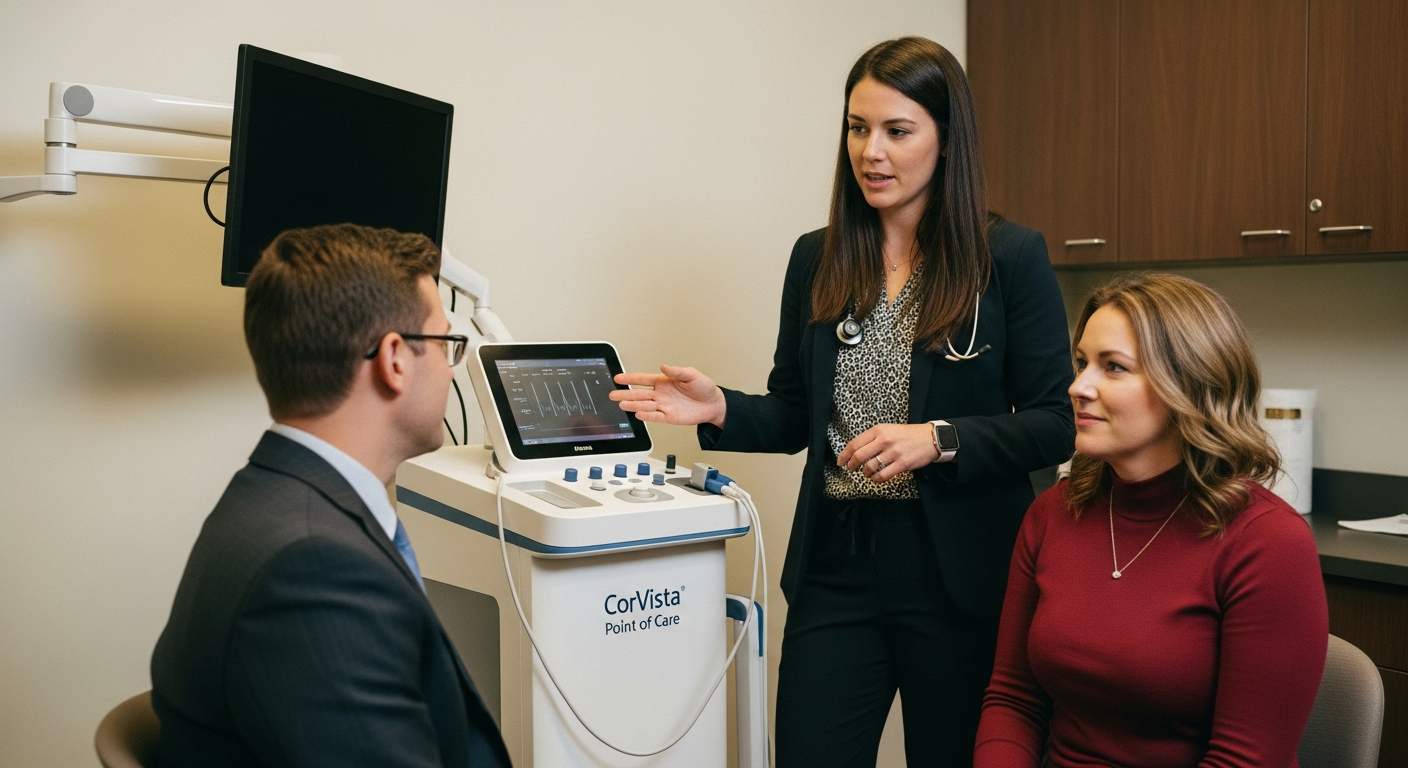
How Your IM Practice Is Leaving Cardiac Revenue on the Table
Three FDA clearances. One point-of-care device. No radiation, no referrals, no 33-day wait. That is what CorVista Health delivered to internal medicine practices between September 2023 and July 2026 — and most practice administrators have not yet done the math on what it means for their revenue.
The CorVista System is now FDA-cleared to assess coronary artery disease, pulmonary hypertension, and heart failure via pulmonary capillary wedge pressure, all from a single resting, non-invasive test delivered in under 30 minutes at the point of care. According to 24x7 Magazine, the CAD Add-On achieved 88% sensitivity and a 99% negative predictive value across 1,816 patients — performance benchmarks that rival hospital-level imaging, without the hospital.
This is simultaneously a clinical urgency story and a financial opportunity that will not stay open forever.
What You Need to Know About Non-Invasive Cardiac Screening for Internal Medicine Practices
Three FDA clearances. One CPT code. A Mayo Clinic collaboration. CorVista Health has moved more in the last twelve months than most diagnostic platforms move in a decade — and most internal medicine practices have not caught up yet.
The CorVista System now covers three major cardiovascular conditions from a single point-of-care platform: coronary artery disease (CAD), pulmonary hypertension (PH), and heart failure assessed via pulmonary capillary wedge pressure (PCWP). No radiation. No contrast agents. No fasting. Results in under 30 minutes during a brief resting test.
- CAD clearance: September 2023 — validated in the IDENTIFY study (N=1,816) with 88% sensitivity and 99% negative predictive value
- PH clearance: April 2024 — FDA Breakthrough Device Designation, validated across 11,000+ patients per BioSpace
- PCWP/heart failure clearance: July 2026 — making CorVista the only single platform covering all three conditions at the point of care
The PH Add-On is one of fewer than 100 breakthrough-designated devices to have entered the US market. That is not a marketing claim — that is an FDA classification that signals unmet clinical need at scale.
In April 2026, CorVista announced a prospective observational collaboration with Mayo Clinic to validate the PH test's accuracy for detection, risk stratification, and referral decisions, according to BusinessWire. For the skeptical IM physician, that institutional signal matters.
The reimbursement path is also now concrete. AMA CPT code 1104T, effective January 1, 2027, covers AI algorithmic analysis for CAD, PH, and elevated PCWP using the CorVista System. That moves this from a diagnostic opportunity to a billable revenue line.
Key Strategies and Best Practices
Cardiac disease is hiding in plain sight inside your existing patient panel. Coronary heart disease affects more than 20.5 million US adults, according to the Journal of the American College of Cardiology's 2026 Cardiovascular Statistics — and the majority of those patients are sitting in internal medicine waiting rooms, not cardiology suites.
The practical question is not whether to screen. It is how to make screening operationally realistic without disrupting patient throughput.
Build cardiac screening into your existing visit workflow
- The CorVista System delivers results in under 30 minutes from a brief resting test — no fasting, no radiation, no contrast agents, no exercise protocol required
- That timeline fits inside a standard extended office visit without adding support staff or restructuring scheduling
- Identify a high-yield patient subgroup first: adults over 50 with dyspnea, fatigue, or metabolic risk factors — conditions already in your panel
Layer conditions strategically — one platform, three billable indications
Following its July 2026 PCWP clearance, the CorVista System now covers conditions accounting for up to 75% of people with symptomatic cardiovascular disease, according to Medical Device Network. That is CAD, pulmonary hypertension, and heart failure assessment — on the same device.
As Doctors Management, a practice management advisory firm, put it directly: "With payer reimbursements flat or declining, ancillary services can represent the difference between a thriving practice and one barely breaking even."
CPT code 1104T, effective January 1, 2027, creates the billing infrastructure to monetize every test you run today. Do not wait until Q4 to map your workflow to that code.
Common Mistakes to Avoid
The biggest diagnostic mistake in internal medicine isn't ordering the wrong test — it's ordering nothing at all. According to a national retrospective cohort study published in PMC (2025), 52.3% of primary care patients with prior heart failure indicators had zero diagnostic investigations recorded, and only 12.5% received natriuretic peptide testing.
That is not a rare outlier. That is standard practice — and it is costing patients their lives.
Three mistakes drive that gap:
- Defaulting to referral as the first step. With cardiology averaging a 33-day wait according to AMN Healthcare's 2025 Survey of Physician Appointment Wait Times, referring and waiting is not a neutral clinical decision — it's a delay with documented mortality consequences.
- Treating symptom ambiguity as a reason to defer. Dyspnea, fatigue, and exertional chest discomfort are frequent primary care presentations. Waiting for symptoms to "clarify" is how pulmonary arterial hypertension (PAH) goes undiagnosed for a median of 2.26 years, per a peer-reviewed analysis in Pulmonary Circulation.
- Assuming in-office cardiac diagnostics require hospital-grade infrastructure. That assumption was accurate five years ago. It is not accurate now.
As Charles Bridges, MD, EVP and Chief Scientific Officer at CorVista Health, noted: "Both PH and elevated LVEDP, particularly when due to HFpEF, are vastly underrecognized and underdiagnosed — often delaying life-saving treatments."
The mistake isn't clinical ignorance. It's a workflow that has no mechanism for acting on what the physician already suspects.
Practical Next Steps
The cardiology access problem is not getting better. According to ReferralMD citing AMN Healthcare's 2025 Survey of Physician Appointment Wait Times, the average cardiology wait is 33 days — a 19% increase from 2022. And a peer-reviewed 2025 study in ESC Heart Failure (Cinza-Sanjurjo et al.) confirmed that delayed cardiology consultation after a primary care referral is directly associated with increased all-cause mortality at one year. Every week you wait to act is a week your patients wait for answers.
Here is what to do now:
- Audit your referral volume. Pull the last 90 days of cardiology referrals. That is your baseline for how much diagnostic revenue is leaving your practice today.
- Verify CPT code 1104T readiness. The AMA's new Category III code takes effect January 1, 2027. Get your billing team aligned before it goes live — not after.
- Request a CorVista clinical overview. The platform delivers results in under 30 minutes with no radiation, no fasting, and no injections. Physician buy-in is faster when the clinical evidence leads the conversation.
- Benchmark your ancillary revenue. According to McKesson Medical-Surgical, ancillary services already account for 11% of IM practice revenue. In-office cardiac diagnostics expand that floor.
The clinical case is proven. The reimbursement pathway exists. The gap in your panel is documented. The only remaining variable is how quickly your practice moves.
Learn how Perfect Rhythm can help your practice implement CorVista cardiac screening today.
Three FDA clearances. A Mayo Clinic collaboration. A new CPT code effective January 2027. In less than four months, CorVista crossed every threshold that separates "interesting technology" from "practice decision you need to make now."
The financial case is not subtle. According to the AMA (via JTaylor), Medicare physician payments have declined 29% in real terms since 2001, with another 2.8% cut in 2025. Ancillary diagnostics are not a nice-to-have — they are how independent practices stay independent.
The clinical case is equally clear. According to Medical Daily, HFpEF accounts for roughly half of all heart failure cases and is routinely missed in primary care. Your patients are carrying diagnoses no one has made yet.
- One platform. Three cleared indications. CAD, pulmonary hypertension, and heart failure — no radiation, no referral, no 33-day wait.
- CPT code 1104T is live January 1, 2027. The reimbursement pathway is no longer theoretical.
- 99% negative predictive value gives you the clinical confidence to rule out serious disease at the point of care — not six weeks later after a cardiology referral.
The practices that move first on in-office cardiac diagnostics will not just serve patients better. They will build a revenue line their competitors cannot easily replicate.
Frequently Asked Questions
What is non-invasive cardiac screening for internal medicine practices?
Non-invasive cardiac screening refers to diagnostic testing for heart conditions — including coronary artery disease, pulmonary hypertension, and heart failure — performed at the physician's office without radiation, injections, or contrast agents. The CorVista System is an FDA-cleared, AI-powered platform that delivers results in under 30 minutes using a resting test.
How does the CorVista point-of-care system work?
CorVista captures physiologic signals from a resting patient and analyzes them using machine learning algorithms validated in clinical studies involving thousands of patients. Results are delivered within 30 minutes, with no fasting, no exercise, and no hospital equipment required.
Is there a billing code for CorVista cardiac screening?
Yes. The AMA granted a new Category III CPT code — 1104T — effective January 1, 2027, for AI-augmented analysis of CAD, pulmonary hypertension, and elevated PCWP using the CorVista System. This establishes a formal reimbursement pathway for internal medicine practices offering this service.
Can internal medicine physicians use CorVista without cardiology involvement?
Yes. The CorVista System is designed for point-of-care use in the physician's office, enabling internal medicine providers to perform initial cardiac evaluation — including rule-out testing with 99% negative predictive value for CAD — before or instead of a cardiology referral. It does not replace cardiologists; it removes unnecessary wait time for patients who do not need a specialist.
Why does early cardiac detection matter financially for a practice?
According to McKesson citing Medical Economics, ancillary services already account for 11% of revenue in internal medicine practices. Adding in-office cardiac diagnostics via CorVista creates a new billable service line from an existing patient panel — without adding staff, referral friction, or capital-intensive imaging equipment.
